Renewable Curtailment Risk In Sub-Saharan Africa: Transmission Congestion And The Next Energy Constraint
Sub-Saharan Africa’s energy transition is increasingly defined by momentum in renewable deployment. Solar parks are expanding across the Sahel and Southern Africa. Wind projects continue to scale along coastal corridors and highland plateaus.
According to the International Renewable Energy Agency, Africa recorded record additions to renewable capacity in recent years, with solar leading the growth. Yet beneath this progress lies a structural vulnerability: transmission congestion.
Globally, renewable curtailment has become a marker of grid stress. In parts of Europe and China, wind and solar generation have been reduced because networks cannot transport available electricity to demand centres. The International Energy Agency warns that grid investment must exceed USD 600 billion annually by 2030 to keep pace with clean energy targets.
While Sub-Saharan Africa has not yet reached the high renewable penetration levels that drive systemic curtailment elsewhere, the region’s transmission capacity remains thin relative to its renewable ambitions. The risk is emerging before the system fully matures.
Curtailment in this context is not a symptom of excess supply. It is a signal of misalignment between generation expansion and transmission readiness. If not addressed, it could quietly erode the economics of renewable projects and slow investor confidence across African power markets.
What renewable curtailment means in African systems
Renewable curtailment occurs when system operators instruct wind or solar plants to reduce output because the grid cannot safely absorb additional power. This may result from transmission congestion, voltage instability or limited interconnection capacity. In economic terms, curtailment reduces actual generation below potential output, lowering project revenues and effective capacity factors.
For Sub-Saharan Africa, the issue is not yet widespread curtailment volumes. It is a curtailment risk. Investors assess grid stability and evacuation capacity before committing capital. Where transmission lines are saturated or expansion plans are uncertain, lenders factor additional risk into pricing models. In emerging markets, even small increases in perceived risk can raise financing costs significantly.
Ember reports that global renewable integration increasingly hinges on system flexibility and network expansion. In Africa, many transmission networks were designed decades ago around centralised hydro generation near demand centres.
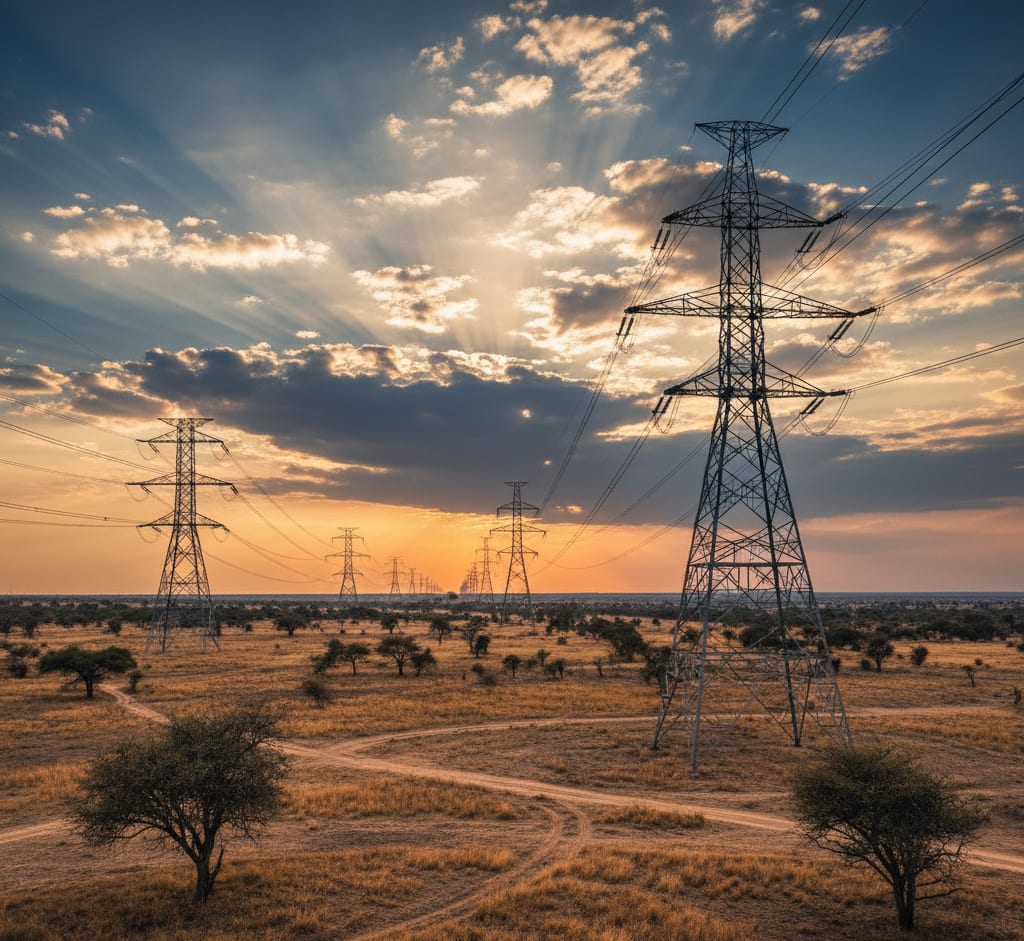
The spatial pattern of new renewable capacity, often located in high-resource but remote areas, demands new corridors and substations. Without them, renewable projects may face delayed grid connections or constrained dispatch.
Curtailment risk, therefore, operates as a financial variable as much as a technical one. It influences project viability, tariff competitiveness and long-term market confidence.
Transmission congestion in practice: country illustrations
Transmission congestion manifests differently across Sub-Saharan Africa’s major markets.
In South Africa, renewable projects have clustered in the Northern Cape, where solar irradiation and wind resources are strong. Yet transmission capacity from this region to load centres has become constrained. Eskom has highlighted limited grid connection availability in key renewable zones, prompting the government to accelerate its transmission development plan. Thousands of kilometres of new lines are proposed, but financing and construction timelines remain extended.
Kenya, with one of the highest renewable shares in Africa, faces a subtler challenge. Geothermal, wind and hydro resources form a strong base, but maintaining reliability requires continuous reinforcement of high-voltage lines and substations. The Kenya Electricity Transmission Company has advanced several strategic corridors, yet demand growth and regional interconnection plans increase complexity.
Ethiopia illustrates another dimension. Large hydro capacity positions the country as a potential exporter within the Eastern Africa Power Pool. However, transmission to industrial zones and cross-border links requires sustained capital outlay. Underinvestment risks leaving generation underutilised.
Nigeria’s system presents stability challenges. Frequent grid disturbances highlight transmission fragility. As renewable ambitions expand under federal and state initiatives, evacuation capacity and network stability will determine integration success.
The financing imbalance between generation and transmission
A persistent imbalance characterises Africa’s clean energy financing landscape. Renewable generation projects attract private and concessional capital through structured power purchase agreements.
Transmission infrastructure, by contrast, is typically financed by state-owned utilities or sovereign-backed borrowing. Its returns are regulated and less immediately visible to investors.
The International Energy Agency has cautioned that globally, grid investment growth lags generation spending. In Sub-Saharan Africa, the disparity is sharper. While renewable pipelines expand rapidly, transmission build-out often trails behind. Long development cycles, frequently five to ten years, contrast with the two-year construction timelines common for solar plants.
Development partners such as the African Development Bank have increased support for transmission corridors and regional integration. Yet capital requirements remain substantial, transmission lines require land acquisition, environmental approvals and cross-jurisdiction coordination, and delays are common.
When generation outpaces transmission, congestion becomes inevitable. This imbalance creates structural exposure: assets are built before evacuation capacity is fully secured. In such circumstances, curtailment risk becomes embedded in project economics.
Investment implications and system reliability risks
Curtailment risk influences both micro-level project finance and macro-level system planning. Developers negotiating power purchase agreements may seek compensation mechanisms for grid unavailability, and utilities facing constrained networks may prioritise dispatch from plants located nearer demand centres, potentially slowing decarbonisation if those plants are fossil-based.
Higher perceived grid risk translates into a higher cost of capital. Sub-Saharan Africa already faces elevated financing costs relative to advanced economies. Any uncertainty surrounding evacuation capacity widens and spreads further, compounds affordability pressures for consumers and increases fiscal exposure where governments provide guarantees.
Transmission congestion also affects reliability. Weak networks can trigger voltage fluctuations and system instability. In markets where demand is growing rapidly, congestion reduces flexibility, and instead of enabling renewable expansion, constrained grids can lock systems into legacy generation patterns.
The International Renewable Energy Agency emphasises that integrating variable renewables requires parallel investment in grid modernisation and digital control systems. Without upgrades, renewable penetration thresholds may be reached prematurely, not because supply exceeds demand, but because networks cannot manage flows effectively.
Conclusion
Sub-Saharan Africa’s renewable momentum is real. Solar and wind technologies are increasingly cost-competitive, and capacity additions continue to rise. Yet the success of this expansion depends on transmission infrastructure that can carry power from resource-rich zones to urban and industrial demand centres.
Renewable curtailment risk in the region remains more anticipatory than systemic. But the structural conditions that generate congestion are visible. Transmission density is low, financing cycles are slow and institutional coordination can be fragmented. Global experience shows that when grid expansion lags generation growth, curtailment follows.
Addressing this risk requires alignment. Transmission planning must be synchronised with renewable procurement, concessional finance must prioritise network resilience alongside generation capacity, and regulatory frameworks must ensure predictable cost recovery for grid investments.
The next constraint in Africa’s energy transition won't be panel efficiency or turbine cost, but whether the wires are strong enough to move power where it is needed. If transmission congestion is allowed to deepen, renewable ambition may outpace infrastructure reality. If addressed early, however, Sub-Saharan Africa can integrate clean energy at scale without repeating the congestion crises observed elsewhere.