Mini-Grids vs National Grids in Africa: Complement or Compromise?
Africa’s electricity debate is often framed in binary terms: centralised national grids on one side, decentralised mini-grids on the other. Policymakers, investors and development partners frequently treat them as competing pathways. But the framing itself may obscure the real question.
In 2026, with nearly 600 million people in sub-Saharan Africa still lacking reliable electricity access, the issue isn't whether mini-grids should replace national grids. It is how both systems interact within a constrained fiscal, institutional and infrastructure environment.
According to the International Energy Agency’s latest electricity outlook, grid investment, not generation cost, is now the primary bottleneck to scaling power systems globally. In Africa, where grid expansion lags population growth, the tension between centralised and decentralised systems is particularly acute.
This explainer clarifies what mini-grids are, how national grids function in the African context, and whether the relationship between them is strategic complementarity or structural compromise.
What is a mini-grid?
A mini-grid is a small-scale electricity network that generates and distributes power locally, typically serving a village, industrial cluster or remote community. It often operates independently from the national grid, though in some cases it may later interconnect.
Most mini-grids in Africa are powered by solar photovoltaic systems, often combined with battery storage and sometimes diesel backup. They are designed to serve communities that are too remote or too costly to connect to central transmission infrastructure.
The World Bank’s Energy Sector Management Assistance Program (ESMAP) estimates that hundreds of millions of Africans live beyond the economic reach of near-term grid expansion, and that mini-grids could serve a substantial portion of these populations.
Mini-grids are attractive for three reasons:
They can be deployed faster than transmission extensions.
They reduce reliance on diesel self-generation.
They can be scaled modularly based on demand growth.
However, they also raise questions around long-term tariff sustainability, regulatory oversight and integration into national planning frameworks.
What is a national grid, and why does it matter?
A national grid is a centralised electricity system that transmits power from large generation plants, such as hydro, gas, coal, solar or wind farms across high-voltage transmission lines to distribution networks serving cities, industries and households.
National grids are capital-intensive. They require large-scale generation assets, long-distance transmission corridors, substations, load-balancing systems, and dispatch centres.
They also underpin industrialisation. Manufacturing, mining, cement production, steel processing and data centres require a stable, high-capacity electricity supply that mini-grids are generally not designed to provide.
The African Development Bank has consistently emphasised that grid expansion and reliability are foundational to industrial growth and economic transformation.
Without robust national grids:
Urban growth is constrained.
Industrial value addition remains limited.
Power-intensive sectors struggle to scale.
Cross-border power trade through regional pools weakens.
The national grid, therefore, is economic architecture, not merely an infrastructure asset.
The investment constraint
The debate between mini-grids and national grids cannot be separated from investment realities.
The IEA notes that global grid investment must increase by roughly 50% by 2030 to keep pace with electricity demand growth.
In Africa, grid financing faces additional structural constraints:
Utility insolvency.
High transmission losses.
Currency risk exposure.
Political pressure to suppress tariffs.
Where national utilities struggle financially, grid expansion slows. In such contexts, mini-grids often emerge as a pragmatic workaround.
Development partners increasingly support decentralised solutions because they are perceived as faster to deploy and less encumbered by legacy institutional constraints.
Yet mini-grids don't eliminate the need for transmission planning. Nor do they resolve systemic weaknesses in utilities; they usually operate around them.
Complementarity: where the model works
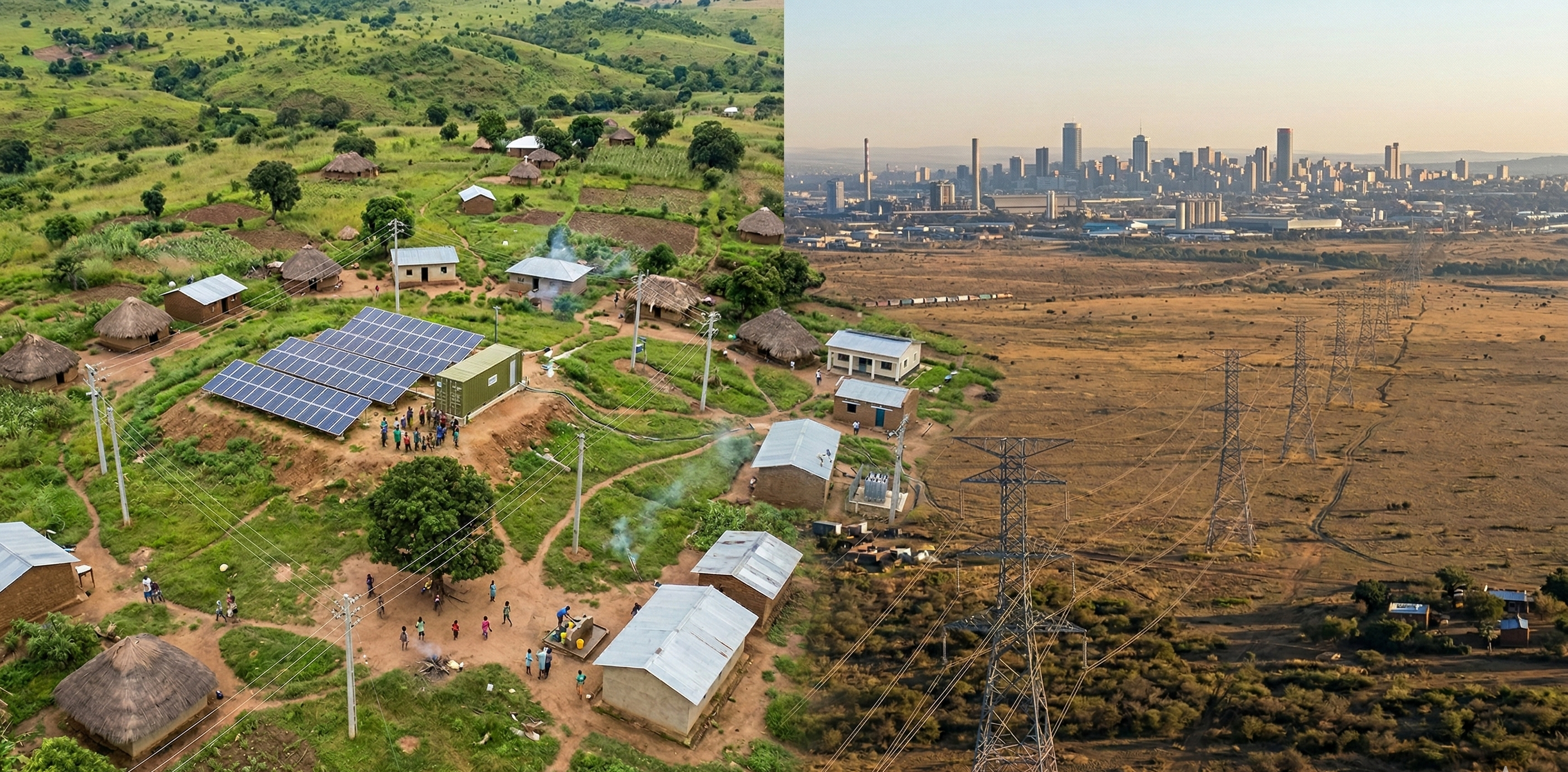
In sparsely populated rural areas, mini-grids can provide essential access without waiting years for transmission corridors to extend.
Nigeria’s Rural Electrification Agency, for example, has supported mini-grid development in off-grid communities through targeted programmes, combining public funding with private operators.
In Kenya, private-sector mini-grid operators have expanded electricity access in arid regions beyond the economic reach of Kenya Power’s grid network.
In such cases, mini-grids serve as access accelerators, and they can also:
Reduce diesel reliance in rural enterprises.
Provide power for agro-processing clusters.
Support local economic activity.
Where designed within national electrification plans, they complement centralised systems by serving peripheral demand nodes. The key condition is coordination.
Mini-grids function most effectively when integrated into long-term national planning, with clear rules on what happens if the central grid eventually arrives.
Compromise: where the risks emerge
The compromise narrative emerges when decentralisation substitutes for systemic reform. If mini-grids become the default solution because utilities cannot expand transmission or reform tariffs, the underlying institutional constraints remain unresolved.
Several risks follow:
Tariff divergence
Mini-grid tariffs are often higher than grid tariffs because of smaller economies of scale. This can create affordability tensions.Regulatory uncertainty
If national grids expand into mini-grid territories without clear compensation mechanisms, private investors face stranded asset risk.Limited industrial scaling
Mini-grids typically cannot support energy-intensive manufacturing or large-scale processing.Fragmentation of planning
Multiple isolated systems can complicate national load forecasting and long-term infrastructure sequencing.
The World Bank and other development institutions increasingly stress the importance of integrated electrification planning frameworks to avoid these outcomes. Mini-grids can become a compromise if they replace rather than complement broader grid reform.
Integration pathways
The emerging policy question isn't mini-grids versus national grids, but how to design integration pathways.
Three approaches are gaining traction:
1. Interconnection-ready mini-grids
Designing systems that can later connect to the main grid without major asset losses.
2. Clear compensation rules
Establishing regulatory frameworks that compensate operators if grid expansion reaches their service areas.
3. National least-cost planning
Using data modelling to determine where grid extension, mini-grids or standalone systems make economic sense.
These approaches shift the debate from ideology to sequencing.
They recognise that Africa’s geography, fiscal constraints and demographic distribution require hybrid solutions.
Why this matters for Africa
Africa’s development challenge is twofold:
First, the continent must expand electricity access rapidly. Hundreds of millions still live without reliable power, particularly in rural and peri-urban areas. Without access, households remain dependent on biomass and diesel, small businesses cannot scale, and basic services such as healthcare and education operate below potential. Mini-grids, especially solar-based systems, can accelerate connections in remote communities where extending transmission lines is economically prohibitive. In this sense, decentralised systems are an essential access tool.
Second, Africa must build power systems capable of sustaining industrial growth. Manufacturing, mineral processing, steel production, fertiliser plants and data centres require high-capacity and stable electricity that mini-grids are not designed to deliver. That scale depends on robust national grids, solvent utilities and coordinated transmission planning.
If Africa leans too heavily on decentralised solutions without strengthening grid infrastructure, it risks entrenching a dual economy, rural access with limited productivity gains, and urban industry constrained by fragile networks. If it prioritises only central grids, access gaps persist, and inequality widens.
The strategic objective is alignment, not substitution. Electricity isn't merely about lighting homes. It is about powering economies, and economies require system coherence.
Conclusion
Mini-grids and national grids are not ideological opposites. They are infrastructure tools serving different geographies and economic functions.
Mini-grids can accelerate access and reduce diesel dependence in remote communities, while national grids anchor industrial competitiveness and macroeconomic growth.
The tension arises when decentralisation becomes a substitute for institutional reform or when centralisation ignores access realities. Africa’s electricity future will likely be hybrid.
The question isn't which system wins. It is whether planning frameworks, regulatory clarity and financial reform allow both systems to function coherently.
In the absence of coordination, complementarity risks becoming compromise, but with system literacy, the two can reinforce each other.